
Social Media, African Teeming Youth Population and the Future of Democracy in Africa
By Oluwaseun Taiwo
“Politics isn’t just happening in parliament anymore. It’s happening in comment sections, on podcasts, in X Spaces, on TikTok Lives, and in WhatsApp groups. And at the centre of this transformation is Africa’s Generation Z.”
There is a familiar narrative that resurfaces whenever elections approach across Africa: young people are apathetic. They do not vote enough, they are disengaged from politics, and they have little interest in governance. It is a convenient explanation for low voter turnout and declining trust in public institutions. But it is also increasingly inaccurate.
The reality is far more interesting.
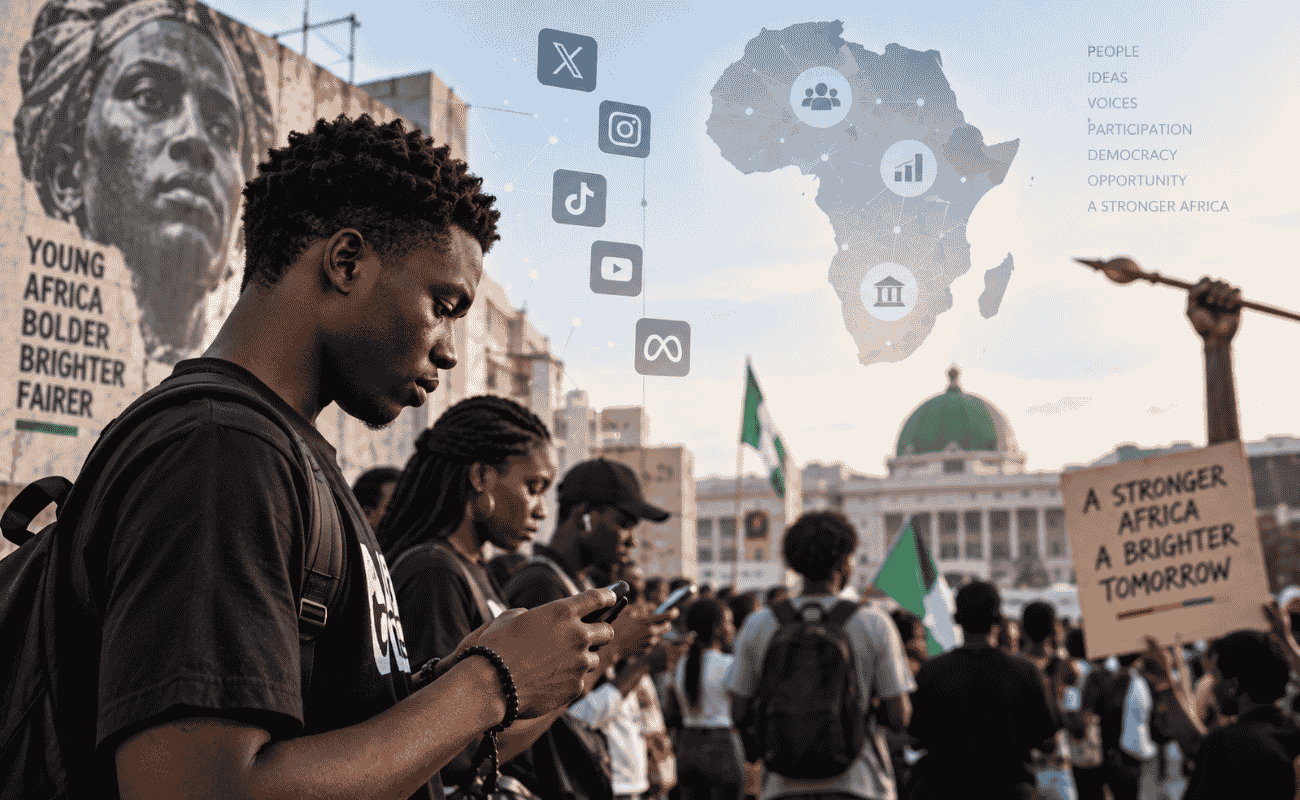
Africa’s young people have not withdrawn from politics but have simply changed the way they participate. They are debating public policy on X, organising civic campaigns on WhatsApp, fact-checking political claims on TikTok, exposing corruption through citizen journalism, and raising millions of voices around issues that matter to them. Politics has become digital, immediate, and participatory.
The challenge, however, is that while young Africans have evolved, many democratic institutions have not.
Generation Z those born roughly between the late 1990s and early 2010s is the first truly digital generation in Africa. They have grown up with smartphones, social media, instant communication, and unlimited access to information. They are not waiting for tomorrow to become leaders; they are already shaping political conversations today.
Unlike previous generations that often relied on political parties, labour unions, or traditional civic associations, Gen Z mobilises differently. A viral video, a trending hashtag, or a livestream can spark national conversations within hours. Information spreads at lightning speed, allowing young people to coordinate, educate, and mobilise across cities and even national borders.
For many of them, civic engagement does not begin at campaign rallies or end at the ballot box. It is woven into everyday life whether questioning government spending, amplifying community concerns, supporting humanitarian causes, or demanding greater accountability from elected officials.
In other words, politics is no longer an event. It has become a continuous conversation.
Perhaps no event better illustrates this transformation than Nigeria’s #EndSARS movement. What began as online outrage over police brutality quickly evolved into one of the country’s largest youth-led civic movements in recent history. Social media became more than a communication tool. It became a platform for organising protests, documenting abuses, raising funds, coordinating legal support, and demanding institutional reforms.
In Kenya, the 2024 youth-led protest against the proposed Finance Bill showcased the political influence of digitally connected young citizens. Without relying on traditional political structures, thousands mobilised through online platforms, forcing policymakers to respond to public pressure.
In Ghana, young citizens continue to leverage digital campaigns to demand transparency and improve electoral accountability. South African youth increasingly use digital platforms to advocate for employment opportunities, better public services, and social justice.
These examples reveal an important shift: young Africans are no longer waiting for institutions to create space for them. They are creating that space themselves.
Despite making up the largest share of Africa’s population, young people remain significantly underrepresented in political leadership.
This is one of the greatest contradictions in African democracy. The continent is the youngest in the world, yet many of its political institutions are led by individuals’ decades older than the populations they govern. Policies affecting education, employment, technology, and digital innovation are often designed with minimal youth participation.
Legislative reforms such as Nigeria’s Not Too Young To Run Act represented important progress by lowering age requirements for certain elective offices. Yet legal reforms alone cannot dismantle deeper structural barriers.
Running for office remains prohibitively expensive. Internal party politics frequently reward political patronage over competence. Campaign financing favours established elites, while young aspirants often struggle to access the networks, resources, and institutional support needed to compete effectively.
Representation is not merely about allowing young people to contest elections. It is about ensuring they influence policy decisions before they become law.
Social media has fundamentally altered the relationship between citizens and governments.
Public officials no longer control political narratives as they once did. A single smartphone recording can shape national debates before official statements are released. Citizens now document elections in real time, expose governance failures, challenge misinformation, and demand accountability with unprecedented speed.
For Generation Z, digital participation is not a substitute for democracy. It is an extension of it.
However, digital activism also presents new challenges.
The rapid spread of misinformation manipulated content, and AI-generated media threatens informed public discourse. Online harassment increasingly targets activists, journalists, and women in politics. Governments across parts of Africa have responded with internet restrictions, tighter regulation of online spaces, and, in some cases, crackdowns on peaceful civic expression.
Such responses misunderstand the nature of today’s civic engagement. Restricting digital spaces does not eliminate public demand for accountability; it merely shifts those conversations elsewhere while deepening distrust between citizens and institutions.
Generation Z expects transparency, responsiveness, and participation. They are accustomed to receiving information instantly and engaging directly with organisations online. Unsurprisingly, they expect governments to operate with similar openness.
Yet many public institutions continue to communicate through one-way announcements rather than genuine dialogue. Public consultations are often limited, feedback mechanisms remain weak, and opportunities for meaningful citizen participation outside election periods are scarce.
If democratic institutions hope to regain public confidence, they must move beyond symbolic youth inclusion.
This means investing in digital civic engagement, strengthening civic education, supporting youth advisory councils, improving transparency, opening policymaking processes, and creating pathways for young people to contribute beyond volunteering during election campaigns.
Listening must become a democratic practice not a political strategy reserved for election seasons.
The future of African democracy will not be determined solely by constitutional reforms, electoral technologies, or campaign promises. It will depend on whether institutions recognise a simple reality: Africa’s young people are no longer spectators.
They are researchers, innovators, organisers, election observers, digital storytellers, entrepreneurs, and community leaders. They are shaping public opinion long before politicians’ step onto campaign stages.
The real question, therefore, is not whether Generation Z is ready to lead.
It is whether governments, political parties, electoral commissions, and public institutions are prepared to engage with a generation that demands participation instead of tokenism, transparency instead of secrecy, and accountability instead of political theatre.
Africa’s democratic future is already being written not only in parliaments and polling units, but also on smartphones, in classrooms, within communities, and across digital spaces where millions of young voices are redefining what citizenship means.
The institutions that recognise this shift will strengthen democracy.
Those that ignore it risk becoming increasingly irrelevant to the very generation that will shape Africa’s future.