
Beyond the Battlefield: Can Diplomatic Dialogue Secure Lasting Peace in Somalia?
By Esther Oniseitan
For more than three decades, Somalia has remained at the centre of regional and international peacebuilding efforts. Since the collapse of Siad Barre’s government in 1991, the country has experienced prolonged political instability, violent extremism, humanitarian crises, and recurring attempts at state reconstruction. Military operations have played a significant role in reclaiming territory from armed groups, particularly Al-Shabaab, but the persistence of insecurity has raised an important question among policymakers and peace practitioners: **Can lasting peace in Somalia be achieved through military action alone, or does it depend equally on sustained diplomatic dialogue?
Military interventions have undeniably contributed to improving security in parts of Somalia. The Somali National Army, supported by the African Union Transition Mission in Somalia (ATMIS) and international partners, has recovered strategic areas that were previously under Al-Shabaab’s control and disrupted the group’s operational capacity. These efforts have created opportunities for governance to gradually return to some regions. However, despite these security gains, attacks continue, political disagreements remain unresolved, and many communities continue to face displacement and humanitarian challenges. This suggests that while military operations can reduce immediate security threats, they cannot by themselves address the political and institutional factors that sustain conflict.
Somalia’s conflict is shaped by multiple and interconnected issues. The collapse of central authority in 1991 left a governance vacuum that contributed to years of civil war and fragmented political authority. Over time, disputes over power-sharing, clan dynamics, constitutional arrangements, access to resources, and weak public institutions created conditions that extremist groups could exploit. Al-Shabaab’s continued presence is therefore not only a security concern but also a reflection of broader governance challenges. Addressing these underlying drivers requires approaches that extend beyond military responses.
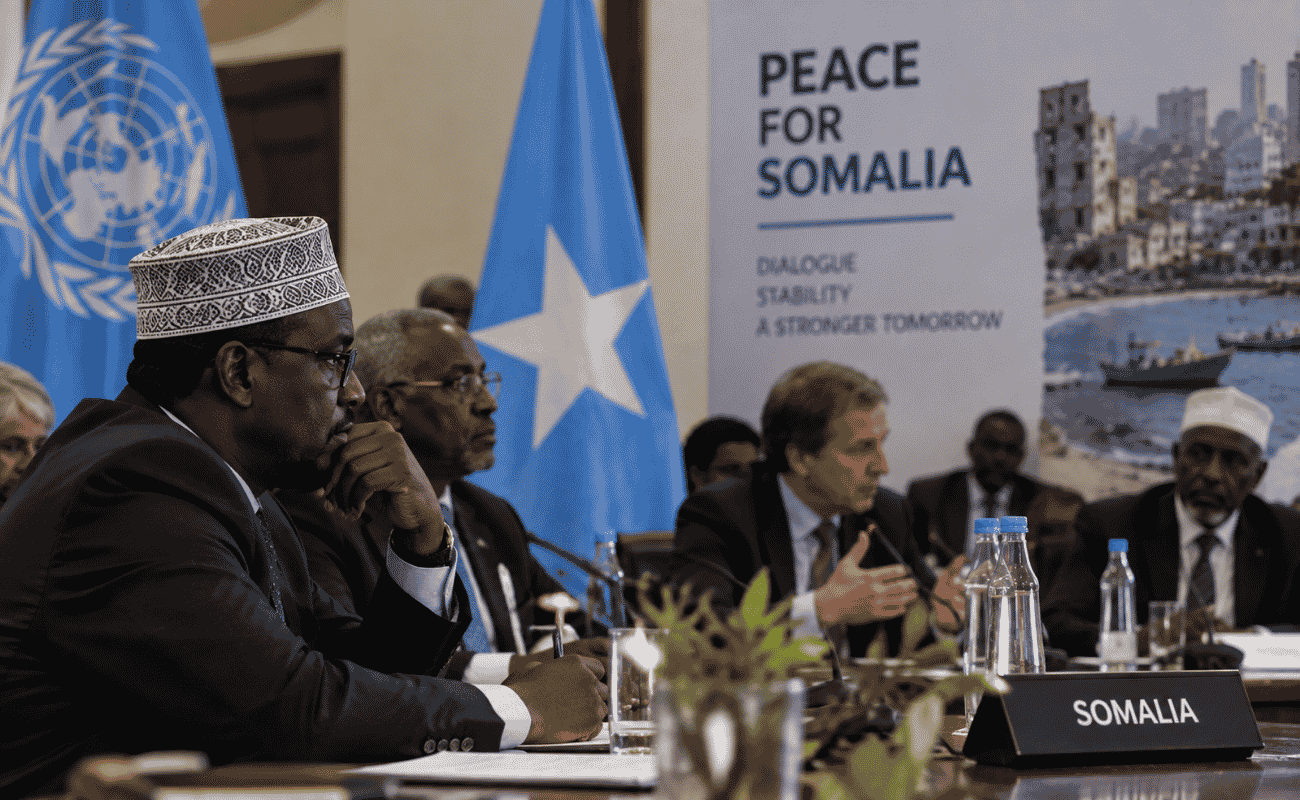
Diplomatic dialogue has increasingly become one of those approaches. In the context of conflict resolution, diplomacy involves more than negotiations between governments. It includes mediation, reconciliation, confidence-building, and dialogue among political leaders, traditional authorities, civil society organisations, women, youth groups, and international partners. Its objective is not simply to end violence but to create the political consensus necessary for sustainable peace.
Somalia has witnessed several diplomatic initiatives over the years, from peace conferences held in neighbouring countries during the early stages of the conflict to more recent negotiations on constitutional reform, elections, and federal-state relations. Regional organisations such as the African Union and the Intergovernmental Authority on Development (IGAD), alongside the United Nations, have supported these processes through mediation, technical assistance, and political engagement. Countries including Türkiye, Kenya, Djibouti, Ethiopia, and Qatar have also contributed to various peace and development initiatives. While these efforts have produced mixed outcomes, they demonstrate that diplomacy remains an essential component of Somalia’s peace process.
An important feature of diplomatic dialogue in Somalia is the recognition of local conflict-resolution mechanisms. Traditional elders have historically mediated disputes within and between communities, relying on negotiation and consensus rather than force. Although contemporary political challenges require formal institutions and constitutional processes, these indigenous approaches continue to play a valuable role in reconciliation efforts, particularly at the community level. Integrating local mechanisms with formal diplomatic initiatives can strengthen both legitimacy and public trust.
At the same time, successful diplomacy depends on inclusive participation. Peace processes that primarily involve political elites may overlook the perspectives of women, young people, internally displaced persons, and civil society organisations, all of whom experience the effects of conflict directly. International experience has consistently shown that inclusive negotiations tend to produce more durable peace agreements because they reflect a broader range of interests and concerns.
Diplomatic dialogue, however, is not a substitute for security or effective governance. Progress toward lasting peace also depends on strengthening state institutions, improving service delivery, addressing corruption, creating economic opportunities, and building public confidence in government. Climate-related challenges, including prolonged droughts and resource competition, further complicate Somalia’s recovery and require coordinated political and developmental responses alongside security measures.
Somalia’s experience illustrates that peacebuilding is rarely achieved through a single strategy. Military operations may create the conditions necessary for dialogue by improving security, while diplomacy provides the framework for resolving political disputes and strengthening institutions. Rather than viewing military action and diplomacy as competing approaches, they should be understood as complementary elements of a broader peacebuilding process.
As Somalia continues its state-building journey, the effectiveness of diplomatic dialogue will depend on sustained political commitment, inclusive governance, and continued cooperation among domestic, regional, and international stakeholders. While significant challenges remain, evidence from Somalia’s peace process suggests that long-term stability is more likely to emerge when security gains are reinforced by political dialogue, institutional reform, and inclusive participation. Lasting peace, therefore, is not secured solely on the battlefield but through the continuous effort to build consensus, strengthen institutions, and address the root causes of conflict.