
From Transit to Destination: How Africa Is Becoming a Global Drug Hub
By Assam Francis
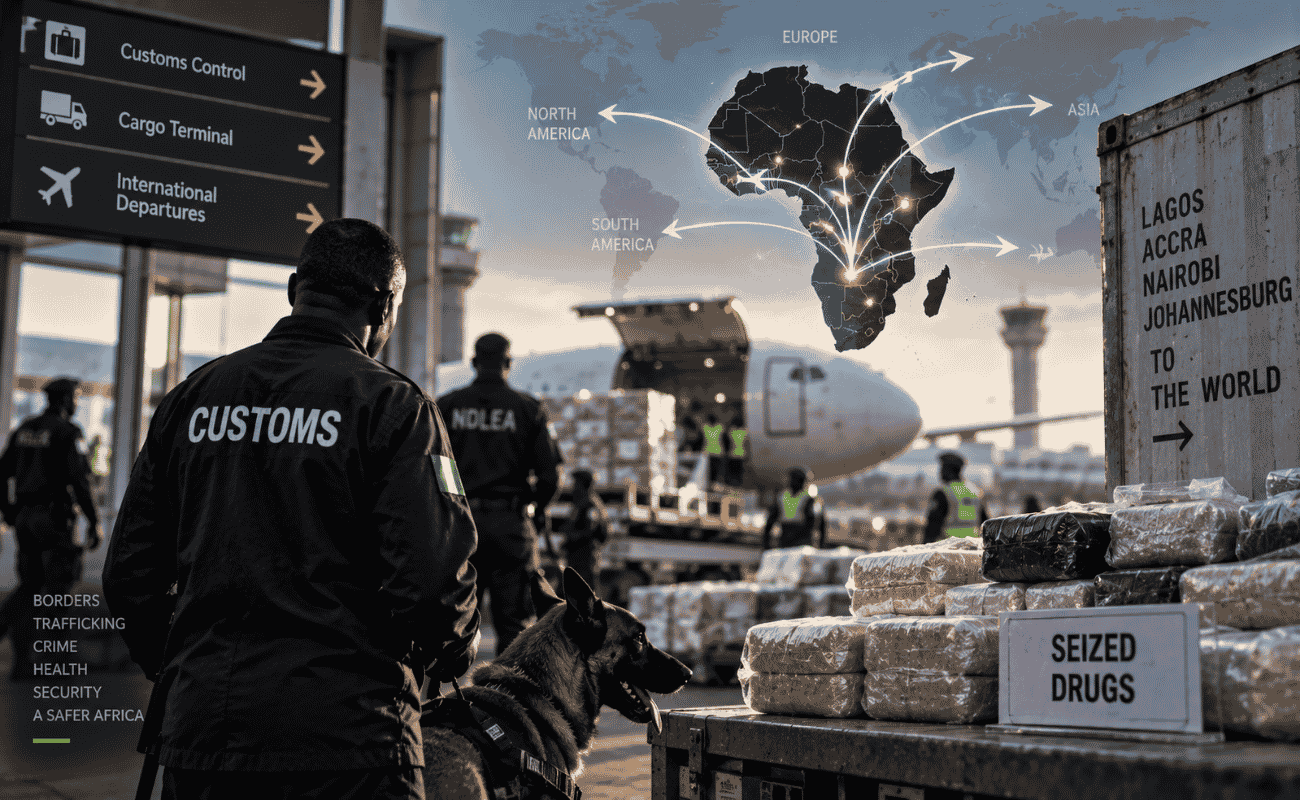
On June 17, 2026, operatives of the Nigeria’s National Drug Law Enforcement Agency (NDLEA) stormed a fortified compound deep in the forest of Tapa Village, Oyo State. What they found wasn’t a small-time drug den. It was a factory. Industrial-scale equipment, precursor chemicals by the ton, and a 56-year-old Mexican methamphetamine expert named Jose Villa Ochoa, flown in specifically to run the chemistry. Four Nigerian collaborators handled logistics and cover. This was the second lab dismantled in Southwest Nigeria this year. The first, in Ijebu East, Ogun State, had yielded 2,419 kilograms of processed methamphetamine worth an estimated ₦480 billion, and three more Mexican nationals now facing trial in Lagos.
These events reveal an important point- A Mexican cartel didn’t just ship product through Nigeria. It relocated production here.
That distinction matters. For decades, the story of drugs in Africa was a story of geography. Cocaine moved from Latin America to Europe, and West Africa’s coastline happened to sit in between. Guinea-Bissau earned the label narco-state for exactly this reason: weak institutions, a long Atlantic coast, and cocaine seizures that once ran to 33 tons in a three-year stretch. The 2024 bust at Bissau’s international airport, 2.63 tonnes off a Venezuela-registered flight, five crew arrested including two Mexicans, a Colombian, an Ecuadorian, and a Brazilian, fit the old pattern perfectly. Africa as corridor. Africa as passageway.
But a corridor doesn’t build meth labs. A corridor doesn’t fly in foreign chemists. What NDLEA uncovered in Oyo and Ogun states signals something else: Africa has become a place where drugs are made, not just moved.
This shift isn’t accidental. Nigeria offers what trafficking networks need to manufacture at a large scale- forest cover, weak rural surveillance, cheap logistics labor, and a judicial system still catching up to synthetic drugs. Mexican cartels bring the expertise; local networks supply the terrain and the muscle. NDLEA Chairman Buba Marwa called it what it is, a transnational syndicate, not a rudimentary setup. His agency’s own language has shifted too, from talk of trafficking routes to warnings about the Southwest becoming a synthetic drug manufacturing hub.
And Nigeria isn’t unique. It’s simply the clearest case. South Africa’s Beitbridge border post intercepted a truck in May carrying 713 kilograms of methaqualone, a precursor for manufacturing, not a finished product for street sale. Two Malawian nationals and a Zambian were arrested. Days later, another truck from Malawi yielded drugs valued at R1 billion, with a sophisticated hidden compartment sealed in steel. These aren’t consumption-market busts. They’re supply-chain interceptions, evidence of production infrastructure being built and fed across borders.
What ties all this together is the international route running through it. The methamphetamine cooked in Ogun State doesn’t stay in Nigeria. NDLEA has separately intercepted fentanyl and meth in parcels bound for the UK, and cocaine hidden inside dried fish heads destined for export. Morocco’s hashish, seized by the tonne near Casablanca and at Tanger Med Port, keeps turning up in French ports. One joint operation this May recovered 2.7 tonnes destined for Lille, with two suspects charged and €34,000 in cash seized. Guinea-Bissau’s cocaine keeps heading for Europe. Africa now sits at both ends of the pipeline, producing on one side, funneling outward on the other.
This is where the story stops being only about drugs.
Trafficking revenue doesn’t disappear into private bank accounts alone. In the Sahel, it feeds insurgency. The UN Security Council has flagged what it calls a deepening nexus between terrorism and organized crime, criminal networks financing armed groups through drug, arms, and human trafficking, layered onto illicit gold trade. JNIM, active across Mali, Burkina Faso, and Niger, now accounts for the majority of recorded attacks in the region, and its financial architecture increasingly overlaps with the same corridors moving narcotics south to the Gulf of Guinea coast. A UN official briefing the Council this July noted something that is hard to ignore: reports that terrorist combatants are themselves using the drugs moving through their territory, not just profiting from them.
So, what began as a story about a forest lab in Oyo State connects, eventually, to men with rifles in the Liptako-Gourma borderlands. That’s the arc worth understanding. Drug production doesn’t stay contained to the lab or the port. It finances the networks that destabilize entire regions.
Where does this leave African governments? Playing catch-up, mostly. NDLEA’s raids are real wins, but a syndicate that loses one lab in Ogun and rebuilds in Oyo within weeks isn’t deterred, it’s adapting. Regional cooperation on precursor chemical tracking remains thin. Cross-border intelligence sharing, the kind that let South Africa’s BMA scanner catch a sealed steel compartment needs to become the rule, not the exception.
Nigeria found a Mexican chemist in its forests. Next time the discovery might come too late.