
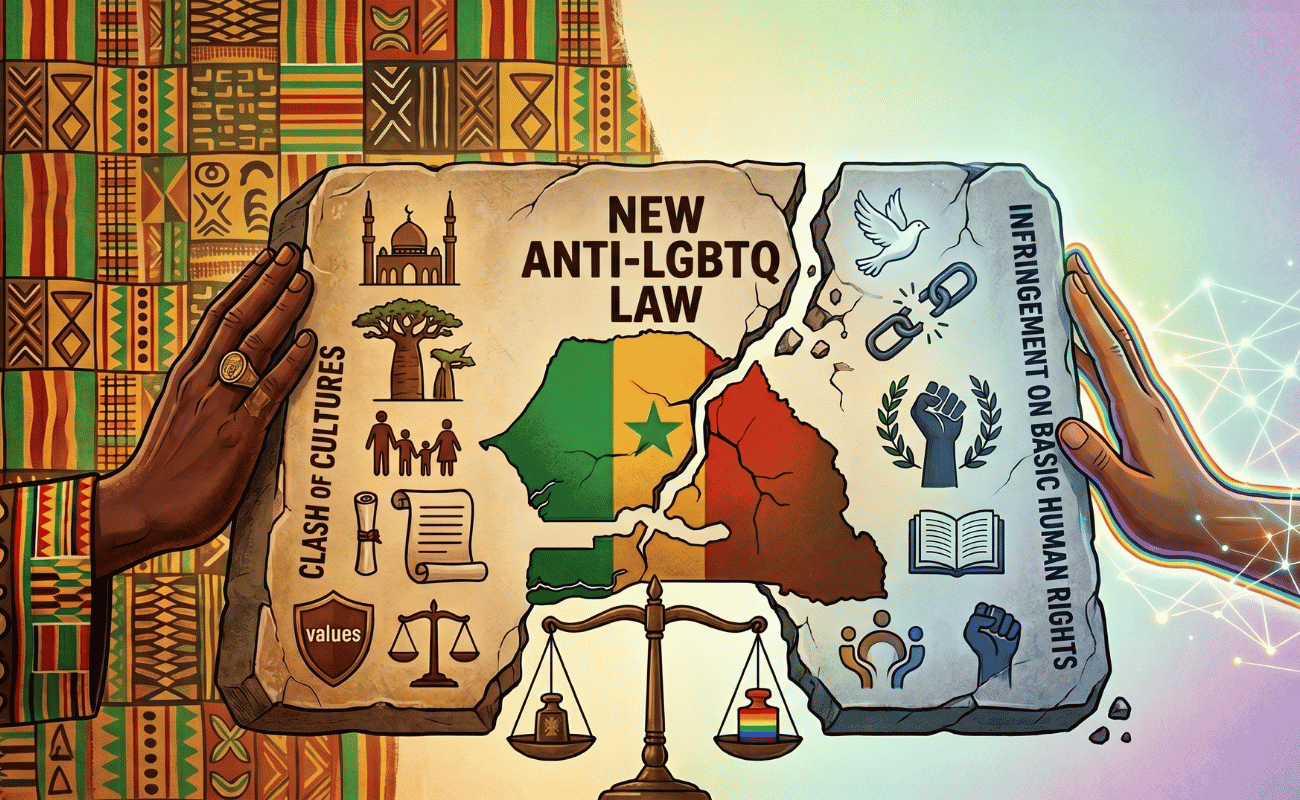
Senegal’s New Anti-LGBTQ Law: Clash of Cultures or Infringement on Basic Human Rights?
By Esther Oniseitan
In March 2026, Senegal drew widespread attention with a new anti-LGBTQ+ law, one of the toughest in West Africa. Under the revised provisions, consensual same-sex relationships could attract prison sentences of up to ten years. Even more striking, simply speaking up for LGBTQ+ rights, organizing meetings, or accepting foreign funding could put individuals at risk of prosecution.
At first glance, some dismissed it as just another legal update. But it quickly sparked intense debate about what it really means for the country, touching on human rights, public health, and even the level of trust within communities. This goes far beyond Senegal. The law highlights a deeper tension between tradition and evolving global ideas about rights and freedoms, alongside growing friction with international expectations. In the case of Senegal, this tension cannot be understood without first recognizing the country’s cultural and religious identity. Senegal is a predominantly Muslim nation, and Islamic teachings play a central role in shaping social values, moral expectations, and community life. Within widely held interpretations of Islam in the country, same-sex relationships are generally regarded as inconsistent with religious doctrine, and this view significantly influences public attitudes.
In this context, the government’s position is largely shaped by domestic cultural realities. Rather than being framed solely as a legal restriction, the law is presented by state authorities as a reflection of societal values and moral consensus. Political leaders have repeatedly emphasized the importance of preserving “Senegalese identity,” which is closely tied to religion, family structure, and communal norms. From this standpoint, the legislation is not seen as an attempt to marginalize a group, but as a mechanism for reinforcing social cohesion in line with the beliefs of the majority population.
Public sentiment in Senegal is broadly conservative on this issue. While attitudes are not uniform, many citizens tend to support strict legal positions on sexuality, viewing them as consistent with religious teachings and cultural expectations. This does not necessarily mean uniform hostility toward individuals but rather support for maintaining public norms that align with long-standing social structures. As a result, the law reflects a form of democratic alignment between governance and prevailing societal values.
From a supportive perspective, this alignment is important. In societies where moral and religious frameworks are deeply embedded in everyday life, governments often derive legitimacy from reflecting those norms in policy. The law, therefore, can be understood as an effort to preserve social order, prevent cultural dissonance, and maintain a shared moral foundation that many citizens consider essential for stability.
The changes are not just about harsher penalties. The scope of the law has expanded significantly, making almost any act interpreted as “promotion” of LGBTQ+ rights a potential offence. That includes open discussions, support groups, and even health outreach. Supporters argue the law reflects and protects Senegalese cultural and religious values in a largely conservative society. However, critics including organizations like Human Rights Watch—warn that it risks suppressing free speech, weakening civic space, and silencing dissenting voices.
While same-sex relationships were already criminalized in Senegal, this law marks a shift in scale and reach. It extends beyond private behavior into public discourse and association. This is particularly significant given Senegal’s commitments under international frameworks such as the African Charter on Human and Peoples’ Rights and the International Covenant on Civil and Political Rights, which guarantee rights to privacy, expression, and non-discrimination. Expanding criminal liability to include advocacy raises questions about whether the country is moving away from these obligations.
For LGBTQ+ individuals, the impact is immediate and personal. The risk of arrest is now coupled with heightened social stigma and surveillance. Reporting abuse or seeking help may expose individuals to further danger. The vagueness of terms like “promotion” adds to the uncertainty raising concerns that professionals such as teachers, healthcare workers, or journalists could be penalized simply for doing their jobs.
Public health experts are also raising alarms. Senegal has historically maintained relatively low HIV prevalence rates, but key populations, particularly men who have sex with men, face significantly higher risks. According to UNAIDS, criminalization can sometimes make access to healthcare services more challenging for vulnerable groups due to fear of stigma or legal consequences. This concern is often used to argue against restrictive legal frameworks.
However, it is important to distinguish between legal regulation and healthcare delivery. The existence of a law does not necessarily prevent the state from maintaining strong, confidential, and accessible healthcare systems for all citizens. Instead, the responsibility lies in ensuring that public health institutions remain non-discriminatory in practice, even within a legally conservative environment.
Supporters of the law would argue that public health objectives should not override the broader social and cultural framework of society. Rather than viewing the legislation as incompatible with health outcomes, the emphasis should be on strengthening healthcare systems, improving outreach mechanisms, and ensuring that fear does not interfere with access to services. In this sense, the law and public health goals are not inherently contradictory but require careful policy coordination.
From a governance standpoint, it is also important to recognize that states must balance multiple priorities simultaneously: cultural preservation, public health, social stability, and international engagement. The challenge is not whether to uphold one at the expense of another, but how to design complementary systems that ensure none of these areas collapse under pressure.
Beyond legal and health concerns, the social consequences are harder to measure but equally important. Criminalization fosters stigma, isolation, and silence not only for those directly affected but also for their families and allies. Trust within communities begins to erode, and the need for secrecy becomes part of everyday life. Over time, this weakens social cohesion.
There are also signs of outward movement, as some individuals seek safety elsewhere. While often quiet and gradual, this kind of displacement has broader implications. When people withdraw from public life or leave entirely, civic participation declines. Conversations become more cautious, and democratic engagement can suffer.
Understanding why this law emerged requires looking at Senegal’s broader social and political context. Deep religious influence, entrenched gender norms, and political incentives all play a role. Leaders often frame such policies as a defense of national identity and moral values. Yet this raises a difficult question: can cultural preservation justify limiting fundamental rights? The answer remains deeply contested.
Importantly, Senegal is not alone. Across parts of Africa, similar tensions are playing out where international advocacy for expanded rights is sometimes viewed as external interference. This creates a complex environment where global norms and local realities do not always align.
Several African countries maintain strict legal positions on same-sex relationships, often grounded in cultural, religious, and historical factors. In Nigeria, for example, the Same-Sex Marriage (Prohibition) Act criminalizes not only same-sex unions but also public displays of same-sex relationships and forms of association or advocacy. In Uganda, legislation has also taken a hardline approach, with some of the most severe penalties globally attached to same-sex conduct and related activities. Kenya and Ghana similarly maintain criminal prohibitions on same-sex relations under colonial-era penal codes that are still in force, even though enforcement levels vary. In Tanzania and Zambia, same-sex relationships are also criminalized under existing legal frameworks, with periodic enforcement and public debate around reform or retention of these laws.
However, the African legal landscape is not entirely uniform. A small number of countries have taken a different approach. South Africa stands out as the most prominent example of legal protection for LGBTQ+ rights on the continent. Its Constitution explicitly prohibits discrimination based on sexual orientation, and it was the first country in the world to constitutionally entrench such protection. Cape Verde, Mozambique, and Seychelles also maintain legal frameworks that do not criminalize same-sex relationships, and in some cases provide limited protections against discrimination. In these countries, the legal approach is more aligned with international human rights norms, although social acceptance still varies significantly.
Meanwhile, in Senegal, civil society organizations are navigating an increasingly restricted space. Many have scaled back LGBTQ+-related work to avoid legal risks, while others have shifted focus entirely. This shrinking space for activism makes it harder for new ideas, reforms, and inclusive policies to emerge.
At its core, this moment represents a broader crossroads for Senegal. Exclusion, especially in areas like healthcare, safety, and civic participation can have long-term consequences for the entire society. When segments of the population disengage from public systems, trust weakens and collective progress slows.
Moving forward, meaningful dialogue will be essential. Lawmakers, religious leaders, civil society actors, and affected communities all have a role to play. Protecting access to healthcare, especially HIV services, should remain a priority. Strengthening legal institutions to ensure consistency with constitutional and international commitments is equally important.
Ultimately, this law reflects Senegal’s effort to balance tradition with changing rights debates. The key challenge is maintaining cultural and religious values while keeping social stability intact. A workable balance depends on protecting access to essential services like healthcare and ensuring laws are applied clearly, without ambiguity in sensitive areas such as education or public communication.
In the long term, stability is strongest when governance stays rooted in local values while still ensuring fairness, consistency, and social cohesion in practice