
Africa’s Critical Minerals: Time to Move Beyond Raw Material Exports
By Oluwaferanmi Fasonyi Adeboye
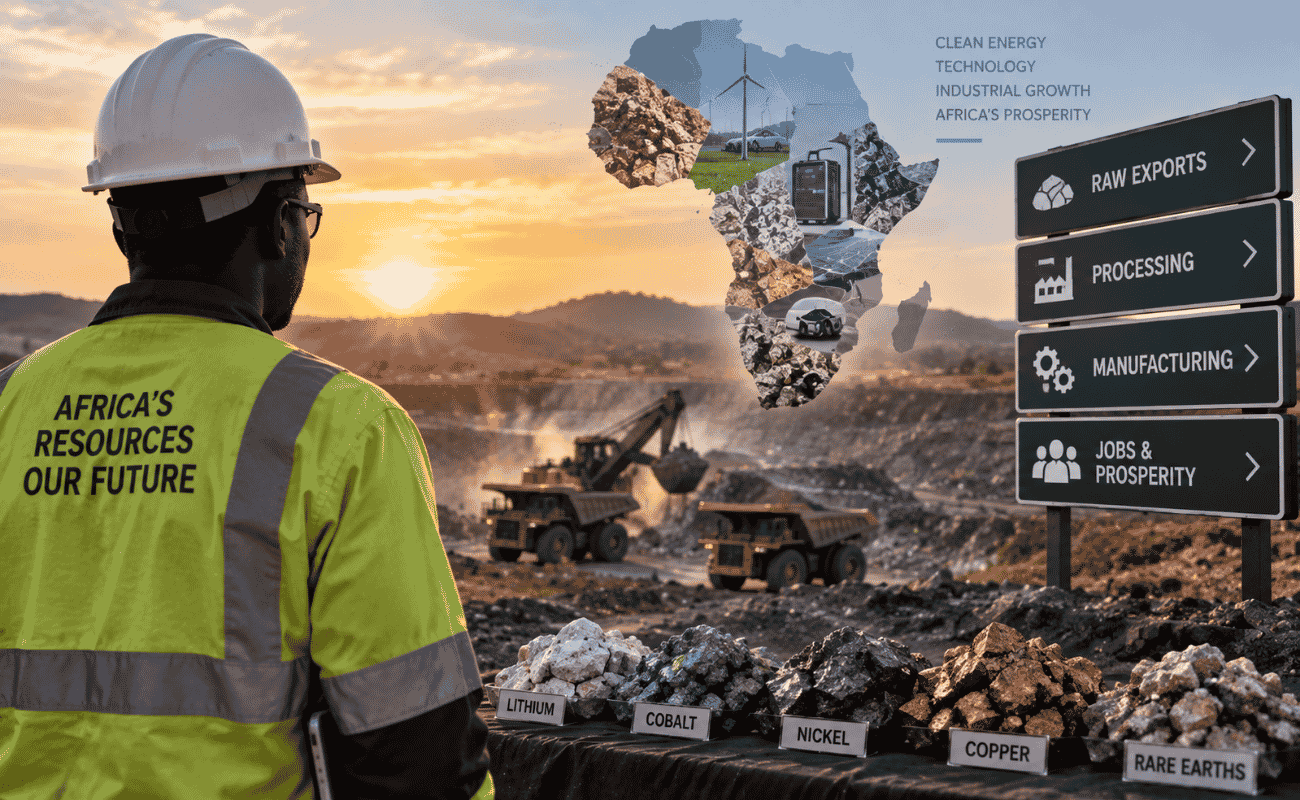
For decades, African countries have exported large quantities of raw materials and minerals to Europe, Asia, and other parts of the world while importing finished products at significantly higher prices. This pattern has often been excused by challenges such as inadequate infrastructure, limited access to capital, technological gaps, and unfair trade barriers. While these obstacles are real, they are not insurmountable if African leaders are ready to think long term. The growing global demand for critical minerals presents Africa with a unique opportunity to rethink its role in the global economy as not only an exporter of raw materials but also as a supplier of processed goods.
The price difference between exported raw materials and imported manufactured goods remains substantial, meaning that much of the value generated from Africa’s resources is captured elsewhere. However, there are signs of change, The Dangote Refinery in Nigeria, recent US–Kenya trade and investment initiatives, and Burkina Faso’s efforts under Captain Ibrahim Traoré to increase national control over mineral resources all reflect a growing push toward value addition and local industrial development. While these initiatives are promising, it is still not enough to conclude that they have fundamentally transformed Africa’s position in the global value chains. For a broader consensus on their effectiveness to emerge, African governments must implement more policies and structures that support local processing, manufacturing, infrastructure development, and regional industrial cooperation. Only through sustained and coordinated efforts can the continent retain a greater share of the value created from its natural resources.
A quick dive into Africa’s resources
According to UNECA and UNCTAD, Africa holds about 55% of global cobalt reserves, 47.65% of manganese, and 21.6% of natural graphite minerals, all that are critical for electric vehicles, batteries, and renewable energy technologies. Yet, many African countries continue to export raw minerals and import finished products at far higher prices.
A clear example is the Democratic Republic of the Congo (DRC), which produces roughly 70% of the world’s cobalt. While cobalt is exported in raw or semi-processed form, most refining and battery manufacturing takes place abroad. As a result, the highest profits, skilled jobs, and technological gains are captured outside Africa, even though the raw material originates on the continent.
The issue is no longer whether Africa has the resources; it is whether it can retain more value from them. Investing in local processing, refining, and manufacturing would create jobs, strengthen industries, increase export earnings, and reduce dependence on imported finished goods. Africa’s future prosperity will depend not on how much it exports, but on how much value it creates before export.
Why the Exportation of Africa’s Raw Materials is a Problem for the Continent
The major problem is the huge difference between the value at which these raw resources are being exported and the price of processed finished goods that are later imported. Even when a rough estimate is made on the supposed cost used in production, logistics and other necessities, the difference is very huge. A realistic example is that of Nigeria’s Crude Oil Paradox. Nigeria is Africa’s largest crude oil producer and one of the world’s major oil exporters. In 2023, crude petroleum accounted for over US$52.5 billion of Nigeria’s exports. However, for many years Nigeria exported crude oil and then imported large quantities of refined petroleum products such as petrol, diesel, aviation fuel, and kerosene because its domestic refineries operated far below capacity. The International Monetary Fund (IMF), noted that despite producing almost 2 million barrels of crude oil per day, only a small fraction was refined locally, forcing the country to rely on imported refined products, the result is that the most economically rewarding stages of the petroleum value chain, refining, petrochemicals, distribution, and marketing were captured elsewhere. According to the U.S. Energy Information Administration (EIA), Nigeria exported about 1.3 million barrels of crude oil per day in 2024 while simultaneously importing an average of 376,000 barrels per day of petroleum products between 2020 and 2024 at exorbitant rates.
How can Africa build a Value-Addition economy, moving from total exportation of raw materials to taking control of the process of production.
Africa can build a value-adding economy by shifting from exporting raw materials to developing industries that process, manufacture, package, and market products locally and export finished goods internationally. This requires more than simply building factories, it involves creating integrated value chains that connect producers, processors, manufacturers, transport networks, and markets. According to the African Development Bank, industrialization must be driven by investments in energy infrastructure, logistics, special industrial processing zones, and competitive manufacturing ecosystems that enable countries to transform their raw materials before export. Similarly, UNCTAD argues that regional value chains under the African Continental Free Trade Area (AfCFTA) can help African countries pool resources, share inputs, and create larger markets for locally manufactured goods. Countries in the continent should work collectively rather than in silos as regional cooperation can allow different countries specialize in different stages of production. By strengthening manufacturing capacity, improving infrastructure, and promoting intra-African trade, the continent can capture a greater share of the value generated from its natural resources, create skilled employment, and reduce dependence on commodity exports.
Conclusion
The global transition to renewable energy technologies, and advanced manufacturing has placed Africa’s critical minerals in the center of the 21st century economy. Yet possessing these resources alone does not guarantee development. The experience of many African countries has shown that exporting raw materials while importing finished products often generates wealth elsewhere, leaving the continent with only a fraction of the value created from its own resources.
The real opportunity before Africa is not simply to increase mineral exports but to move up the value chain. This means investing in processing facilities, industrial infrastructure, technical skills, and regional supply chains that allow African countries to participate in production rather than remain suppliers of raw material only. While this transformation will require substantial capital, policy changes, and long-term planning, the cost of maintaining the present status quo is far greater and economically draining.
Africa’s critical minerals can either reinforce a pattern of dependence or serve as the foundation for industrial transformation. The difference will be determined not by the resources the continent has, but by the decisions made regarding those resources. The future of Africa’s mineral wealth should therefore be measured not by how much is exported out of the continent, but by how much value remains within it.
References
African Development Bank (AfDB). (2025). Industrialize Africa. https://am.afdb.org/ar/node/4823
African Development Bank (AfDB). (n.d.). Industry & Services. https://www.afdb.org/en/industry-services
International Monetary Fund (IMF). (2019). Nigeria: 2019 Article IV Consultation—Staff Report. https://www.imf.org
Okoro, E., Dosunmu, A., Igwilo, K., Anawe, P., & Mamudu, A. (2017). Economic Advantage of In-Country Utilization of Nigeria Crude Oil. Open Journal of Yangtze Oil and Gas, 2(4), 226–236.
U.S. Energy Information Administration (EIA). (2025). Nigeria Country Analysis Brief. https://www.eia.gov
UN Trade and Development (UNCTAD). (2016). African Continental Free Trade Area: Developing and Strengthening Regional Value Chains in Agricultural Commodities and Processed Food Products. https://unctad.org/publication/african-continental-free-trade-area-developing-and-strengthening-regional-value-chains
UN Trade and Development (UNCTAD). (2025). Evidence and Potentialities of Regional Value Chains in Sub-Saharan Africa Using Cumulation. https://unctad.org/publication/evidence-and-potentialities-regional-value-chains-sub-saharan-africa-using-cumulation
World Integrated Trade Solution (WITS), World Bank. (2025). Nigeria Trade Profile. https://wits.worldbank.org