
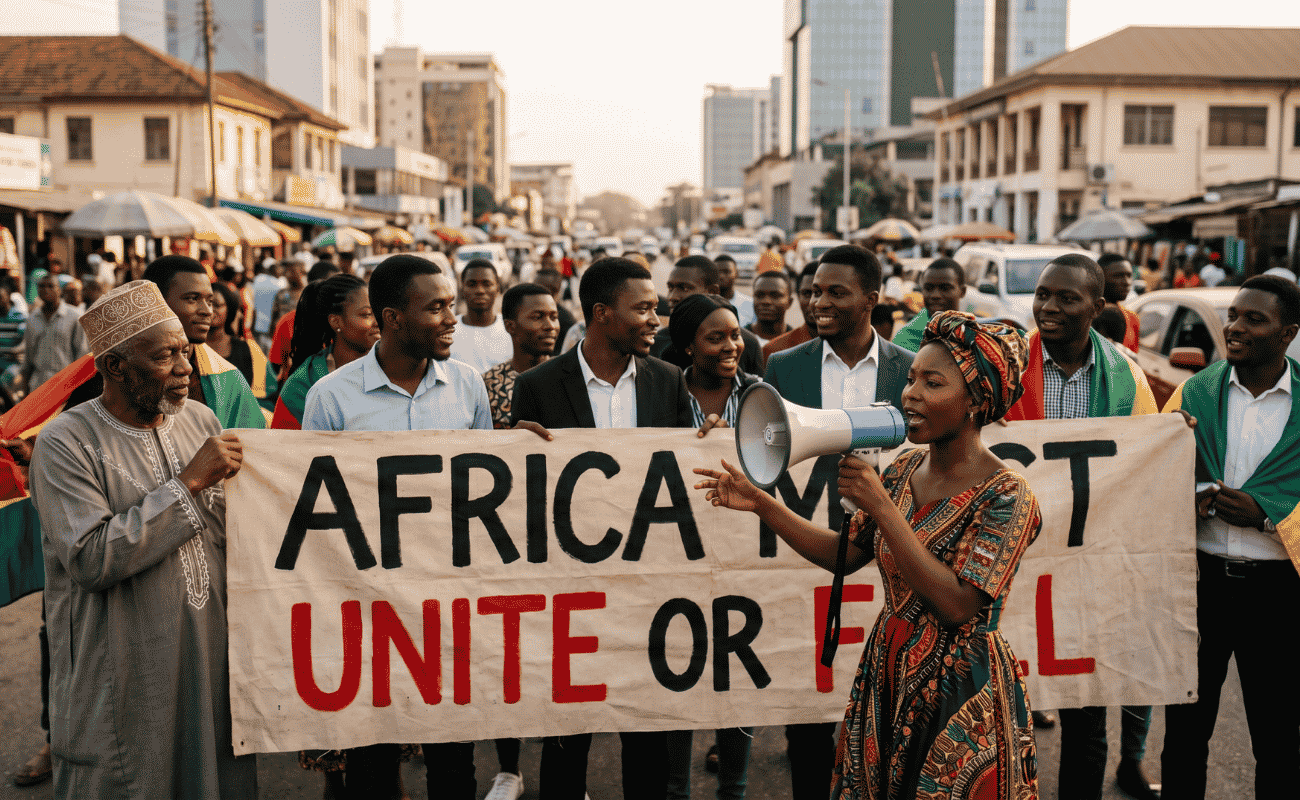
Africa Must Unite or Fall
By Assam Francis
The world is on fire, and nobody is pretending otherwise anymore. Russia’s war on Ukraine is grinding through its fourth year. Israel has gone from Gaza to Lebanon to a direct exchange with Iran, with America watching its back the whole time. The threat to the Strait of Hormuz, through which roughly one-fifth of global oil moves, is not hypothetical anymore. In South Asia, Afghanistan and Pakistan are edging toward something that could pull the entire region into open conflict. The world has not stumbled into chaos. It chose it, option by option, interest by interest.
And in the middle of all of this, there is Africa. A continent with everything it needs to be great, still watching from the corner, still waiting on itself.
Let me be clear about something, Africa is not poor. Africa is sitting on roughly 30 percent of the world’s mineral wealth. Its youth population is on track to make up more than 40 percent of the global workforce by 2100. Its land, its rivers, its coastlines, they are not the problem. The problem is what African governments keep doing, or refusing to do, with all of it. We have resources. What we do not have is the courage to use them for ourselves.
The past few weeks brought back something I am honestly tired of having to talk about. Xenophobic attacks in South Africa against fellow Africans, Nigerians, Zimbabweans, Mozambicans, have returned. They always return. And every time, the conversation comes back to the same uncomfortable truth: South Africa did not free itself.
To understand why this hurt, Ghana’s President John Mahama said it plainly: Other African countries sheltered the ANC when the apartheid regime was still being recognised by much of the West. African people funded, marched, and agitated for South Africa’s freedom. So when South Africans today chase other Africans out of townships with violence and mob force, it is not just cruelty. It is ingratitude so deep it almost takes your breath away. The irony is too heavy. The continent that fought hardest for your freedom is the one you are now running out of your country.
I wrote about Sudan before. I will keep writing about it until people stop looking away. Nearly 14 million people have been displaced, the largest displacement crisis on earth right now. Over 150,000 dead by some estimates. Hospitals bombed. Preschools hit by drones. Cholera moving through communities that no longer have clean water. And the AU? It convened panels. It urged ceasefires. It issued statements. Sudan kept burning.
Two years of statements. Tens of thousands more bodies. That math is not complicated. That is an institution that has decided that process matters more than people.
In Mali, JNIM, the al-Qaeda-linked jihadist coalition, is not hiding. It is blockading cities, cutting off supply routes, and expanding its territory with an organisation that the Bamako junta simply cannot match. And that junta, the one that kicked out the French, broke with ECOWAS, and invited Wagner in, is more focused on staying in power than on stopping the takeover.
That is the part that should worry all of us. Because JNIM does not recognise borders. A jihadist-controlled Mali is a door into Senegal, Cote d’Ivoire, Guinea. The spillover is not a risk. It is already happening. And ECOWAS, the body best placed to coordinate a response, is watching a junta protect its regime while an insurgency grows past every line the bloc has drawn. We need to call that what it is: failure.
Here is the uncomfortable truth: foreign powers do not impose themselves on Africa. African leaders invite them. Weak institutions, corrupt procurement, debt that is structured to depend on external bailouts, these are not accidents. They are conditions that external powers, China, the USA, Russia, Gulf states, and the West have all learned to work with. Resources flow out. Weapons flow in. Sovereignty becomes something leaders talk about at the General Assembly.
It should come as no surprise that every young African crossing the Sahara or boarding a boat in the Mediterranean is making a calculation. They are not leaving because they lack ambition. They are leaving because they have correctly decided that the risks of crossing are better odds than the certainty of being locked out at home. Hundreds of thousands leave every year. And until African governments treat youth employment and political inclusion as a security question rather than a development slogan, the continent will continue to lose the very generation it needs most.
And overseeing all of this is an institution that was built for exactly this moment. The African Union. It meets. It releases communiques with language so careful it says nothing. On the questions that matter, it consistently finds a procedural reason to hold back. The principle of non-interference, which was meant to protect sovereignty, has become a cover for impunity. The AU did not stop the coup wave in West Africa. It has not stopped Sudan. It has not slowed the jihadist advance in the Sahel. An institution that cannot act when the continent is on fire is not a conscience. It is a conference room.
The answer, frustrating as it is, already exists. The African Continental Free Trade Area is on paper. A real common defence posture is overdue in practice. The architecture of continental unity has been designed and redesigned at summit after summit. What is always missing is the political will to do it. That means reforming the AU so it can act, not just convene. It means ECOWAS is enforcing its own frameworks. It means African governments choosing each other over foreign patrons who have never once put African lives first.
I am not writing this as an outsider. I am writing as someone who believes, stubbornly, that this continent has everything it needs to be what it keeps promising to become. But belief alone does not build anything. The question is not whether Africa can afford to unite. We have seen what division costs. We are still paying it.
The question is simple: how much longer are we going to wait?