
MIGRATION, XENOPHOBIA AND THE FUTURE OF AFRICAN INTEGRATION: LESSONS FROM SOUTH AFRICA
By Angel Garba
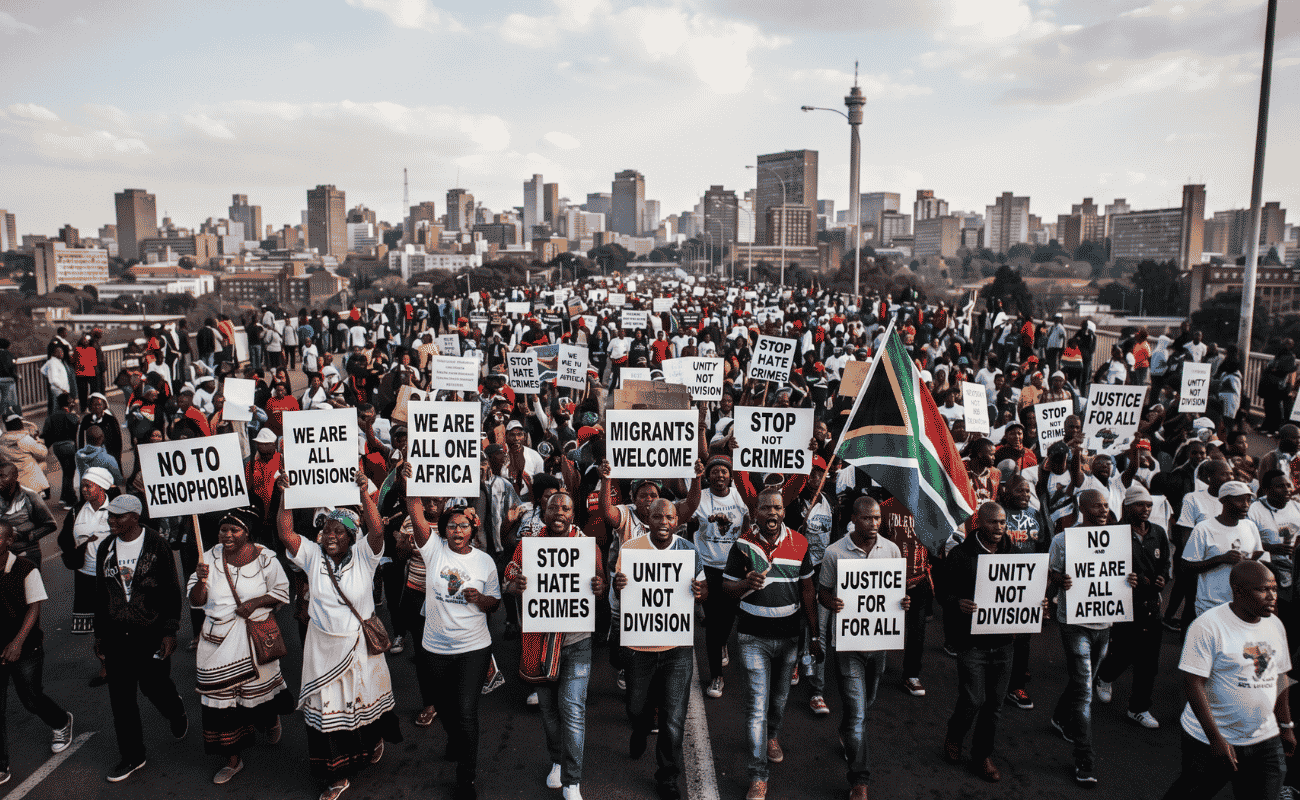
Modern South Africa remains caught between its aspirational future and the structural fractures left by colonialism and apartheid. While the country transitioned to democracy with immense global goodwill, its internal social dynamics reveal a deeply troubled post-colonial psyche. The coexistence of diverse racial demographics has long been the focus of international study. However, the most critical threat to South Africa’s regional standing is not internal racial friction, but its systemic, violent rejection of other African nationals. This crisis challenges the core tenets of African solidarity and demands a critical evaluation of migration management in the region.
Deconstructing the Rhetoric: Xenophobia vs. Afrophobia
Migration is a natural socio-economic phenomenon driven by a variety of survival and advancement strategies, including conflict displacement, economic aspiration, and familial realignment. Yet, within the South African borders, this routine global process triggers extreme hostility. While this prejudice is widely labeled as “xenophobia,” the term is analytically incomplete. Xenophobia implies a generic aversion to all foreign nationals. In South Africa, however, the hostility is highly selective, manifesting overwhelmingly as Afrophobia—a targeted bias against black continental migrants.
According to Landau, Ramjathan-Keogh, and Singh (2015), underscores that South Africa operates as a highly hostile environment for non-nationals, where the human rights of African migrants are routinely devalued. This discrimination is not merely a grassroots issue. It is structurally reinforced by State bureaucrats who deny administrative justice to asylum seekers, Law enforcement officials who engage in systemic harassment and extortion, Private security firms managing detention and deportation facilities with little accountability. This institutional hostility persists despite repeated government promises of reform. Official plans to leverage migration for economic development, secure public health, protect human rights, and drive regional integration have failed. In their place, a culture of impunity and extrajudicial violence (“jungle justice”) has taken root.
The Demographics and Data of Exclusion
The focus on the attitudes of black South Africans toward fellow continental migrants is driven by two empirical realities. The Proximity of Interaction, Research by Jonathan Crush (2000) notes that while white South Africans harbour statistically severe anti-immigrant views, they rarely interact with migrant communities or execute street-level immigration enforcement. The Target of Hostility, Public anger and physical violence are almost exclusively directed at black Africans and, increasingly, South Asian shopkeepers, while foreign white populations remain unmonitored and unthreatened.
The depth of this anti-African sentiment is captured in stark national datasets which state that 25% of South Africans support an absolute ban on all immigration, a rate far higher than any other nation in the Southern African Development Community (SADC), 20% demand the immediate deportation of all citizens from neighbouring African states, irrespective of their legal documentation, 87% believe the state admits an excessive number of foreign nationals, 64.8% of respondents in a Witwatersrand University survey stated that the total exit of African refugees and immigrants would be a positive development for the country.
Economic Scapegoating and Political Complicity
This public hostility is directly fuelled by political leaders who use vulnerable populations as economic scapegoats. As Mattes et al. (2002) argue, immigration is treated as an existential threat rather than a development tool. This narrative creates a false dichotomy between domestic empowerment and skilled migration.
This political strategy was institutionalized early in the democratic era by former Home Affairs Minister Mangosuthu Buthelezi, who warned parliament:
“If we as South Africans are going to compete for scarce resources with millions of aliens who are pouring into South Africa, then we can bid goodbye to our Reconstruction and Development Programme.”
By branding the employment of migrants as “unpatriotic” and accusing them of draining healthcare, housing, and social resources, early leaders built the framework for modern violence. This rhetoric remains active at the municipal level. In Johannesburg, local leadership has consistently pointed to migration as the primary source of strain on public infrastructure and employment. In an economy burdened by unemployment rates exceeding 40%, these official statements turn migrants into targets for citizens frustrated by poverty and state failure.
The Human Cost: A Chronology of Violence
The theoretical failure of Pan-Africanism manifests on the ground as physical violence. This systemic violence directly disrupts major continental initiatives, including the African Continental Free Trade Area (AfCFTA). The human cost is documented through a continuous cycle of targeted attacks:
Recorded Fatalities (April–May 2026)
- Mozambican Migrants (29–30 May 2026): Five citizens were killed in targeted communal violence in Mossel Bay, Western Cape, alongside two related fatalities.
- Ethiopian Entrepreneurs (26 April 2026): Five migrants were killed during armed actions targeting foreign-owned small businesses in Johannesburg, including three victims shot inside a commercial venue.
- Nigerian Nationals: The Nigerian Consulate has documented numerous targeted deaths, including Amaramiro Emmanuel (20 April 2026) Suffered brutal, fatal injuries after being beaten by personnel from the South African National Defence Force (SANDF) and Ekpenyong Andrew (19 April 2026) Apprehended in the Booysens area of Pretoria after an altercation with Tshwane Metro Police officers. His body was discovered in the Pretoria Central Mortuary the following day.
Historical Precedents (2018–2019)
- Samuel Nkennaya: April 27, 2019; he succumbed to his injuries and died in the hospital on April 28, 2019, after being mobbed based on false allegations of kidnapping.
- Ebuka Udugbo: Died in April 2019 while under state law enforcement custody.
- Clement Nwaogu: Burned to death by a mob in Rustenburg in April 2018.
- Francis Ochuba & Chidi Ibebuike: Targeted and killed in separate early 2018 incidents.
- Martin Ebuzoeme & Ozumba Tochukwu-Lawrence: Fatally attacked in Johannesburg and Mpumalanga.
Strategic Lessons for the Continent
The continuing crisis in South Africa offers three clear lessons for the future of African integration:
- Domestic Self-Reliance Over Migration: African states must focus on building stable domestic economies and governance structures. Relying on regional migration as an economic safety valve exposes citizens to severe physical danger.
- Realism in Continental Statecraft: Pan-Africanism cannot survive on historical sentiment alone. International relations on the continent are driven by state self-interest. Migrants cannot rely on historical anti-apartheid solidarity for physical security.
- The Need for African Union Accountability: The African Union (AU) must transition into a proactive enforcement body. There must be formal economic, political, or diplomatic penalties for member states that fail to uphold the human rights of continental migrants. Without institutional consequences, South Africa has no incentive to alter its domestic policy.
Conclusion: The Ultimate Cost
The ongoing violence in South Africa cannot be dismissed as generic xenophobia; it is a specific, structural rejection of the African continent. By allowing Afrophobia to dictate its social and economic landscape, South Africa actively undermines the possibility of true continental integration. The state must ultimately calculate the cost of its actions; how much its moral authority and continental influence it is willing to destroy to protect a broken system of internal exclusion.
REFERENCES
Landau, L. B., Ramjathan-Keogh, K., & Singh, G. (2005). Xenophobia in South Africa and problems related to it (Forced Migration Working Paper Series No. 13). University of the Witwatersrand
Crush, J. (2000). The dark side of democracy: Migration, xenophobia and human rights in South Africa. International Migration, 38(6), 103–133. https://doi.org/10.1111/1468-2435.00145
Mattes, R., Crush, J., & Richmond, W. (2002). Understanding press coverage of international migration in Southern Africa since 1990 (Migration Policy Series No. 27). Southern African Migration Project.
The Mozambique Consulate
The Ethiopian Consulate
The Nigerian Consulate
The Cable news, April 2026