
Nigeria’s Failing Education System, Brain Drain and the “Japa” Question
By Lydia
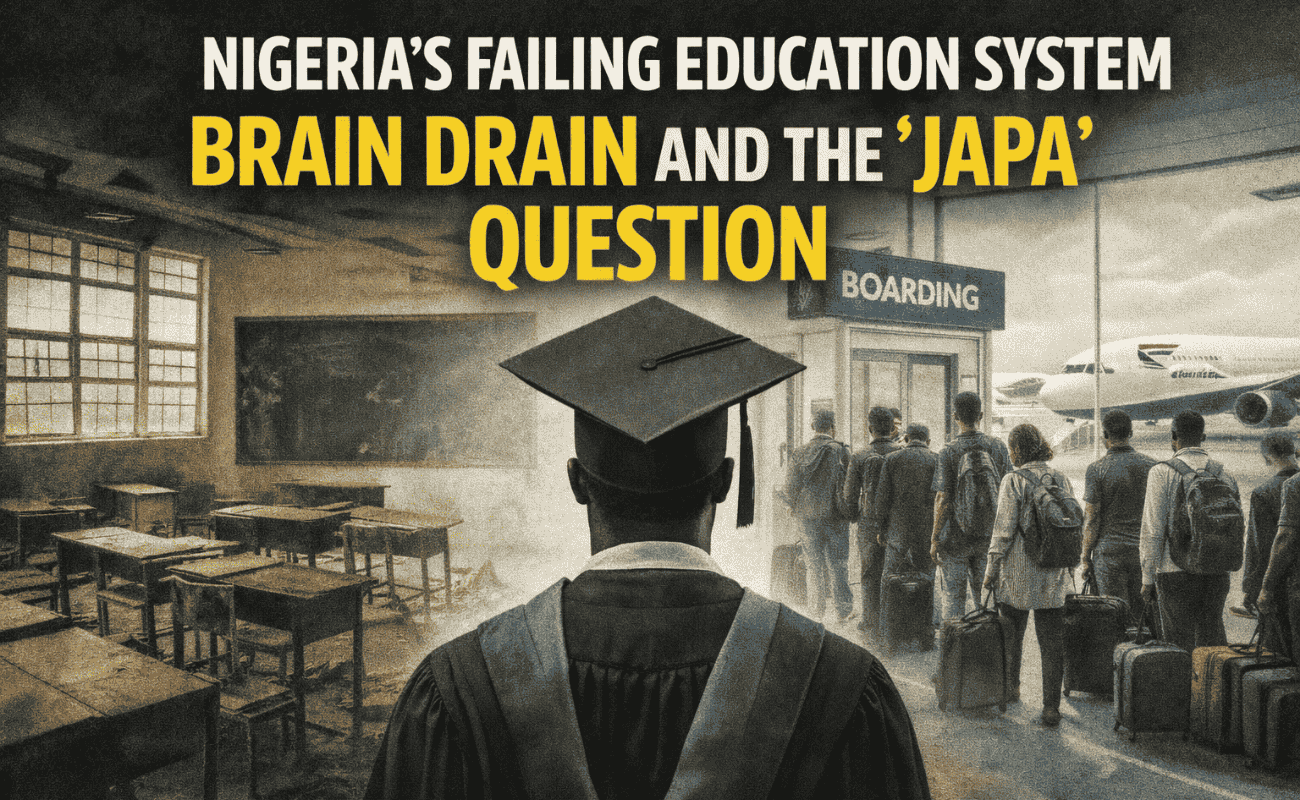
It is no longer news that Nigeria’s educational curriculum is outdated and that the quality of education in the country is steadily declining. From dilapidated classrooms and underfunded institutions to incessant strikes and curricula that lag behind global realities, the education sector reflects a system struggling to keep pace with the demands of the modern world. However, the continuous rise of the “japa” syndrome among Nigerians reveals that the crisis goes far beyond economic hardship.
“Japa” is a Nigerian slang that means to leave quickly or deliberately to escape difficult conditions. In today’s context, it refers to the mass migration of Nigerians (especially young people and professionals) to other countries in search of better opportunities.
The “japa” movement is often framed as a desperate chase for higher wages, but for many Nigerians, it is a vote of no confidence in an educational system that feels outdated, underfunded, and disconnected from today’s realities.
At its core, education is meant to prepare citizens for productivity, innovation and national development. In Nigeria, however, it has increasingly become a source of frustration. Graduates leave universities armed with certificates but lack the practical and analytical skills demanded by both local and global labour markets. Employers complain of unemployable graduates, while graduates lament an education system that fail to equip them for life beyond the classroom. This growing disconnect has steadily eroded trust in Nigerian qualifications.
As confidence in local education declines, many young Nigerians are turning to foreign degrees and professional certifications as a form of insurance. Certifications from the UK, Canada, the United States, and Europe are increasingly perceived as more credible, relevant, and globally competitive than local alternatives. This hunger for foreign validation is not merely about prestige; it reflects a legitimacy crisis within Nigeria’s education system. When citizens feel compelled to seek external validation to be taken seriously, it signals a deep institutional failure.
This crisis feeds directly into Nigeria’s brain drain problem. Brain drain in Nigeria is not simply the physical movement of people across borders; it is the systematic loss of human capital from a weakened state. Highly trained professionals like doctors, academics, engineers, policy experts and innovators are leaving in large numbers, often at the peak of their productivity. These are individuals who should be strengthening institutions, driving innovation, and shaping national development.
The irony is striking. Nigeria invests limited resources in educating its population, only for other countries to reap the benefits. Universities lose their brightest graduates to postgraduate opportunities abroad, many of whom never return. The academic pipeline weakens as potential lecturers, researchers and mentors exit the system, further diminishing the quality of education for those left behind. In this way, brain drain is both a consequence of a failing education system and a force that actively worsens it.
Over time, this dynamic becomes self-reinforcing. As migration is normalized and even celebrated as the ultimate marker of success, institutions struggle to retain talent or inspire long-term commitment. Excellence is rewarded with exit rather than opportunity at home. The result is a vicious cycle: poor educational quality fuels migration, migration weakens institutional capacity, and weakened institutions further degrade education. National development suffers as innovation slows, governance capacity declines, and critical sectors remain understaffed.
It is important to stress that the “japa” phenomenon should not be reduced to individual selfishness or a lack of patriotism. People respond rationally to dysfunctional systems. When education no longer guarantees competence, opportunity, or dignity, migration becomes a logical response. The issue, therefore, is not ambition; it is systemic failure.
Nigeria’s development aspirations cannot be realized without restoring confidence in its educational institutions. This requires more than increased funding, though funding remains essential. It demands curriculum reform aligned with contemporary global and local needs, stable academic calendars, investment in research and innovation, and deliberate policies that link education to industry and national development goals. Most importantly, it requires political will to treat education not as a budgetary obligation, but as a strategic investment in national survival.
Until Nigeria rebuilds an education system that produces globally competitive graduates who can thrive at home, brain drain will persist and “japa” will remain less of a choice and more of an escape. Airports will continue to replace classrooms as symbols of hope, and certificates will continue to function as passports rather than tools for national transformation. Reversing brain drain does not begin at the borders; it begins in the lecture halls