
Why Africa’s Young People Are Leaving and what it means for the Continent’s future
By Oluwaferanmi Fasonyi Adeboye
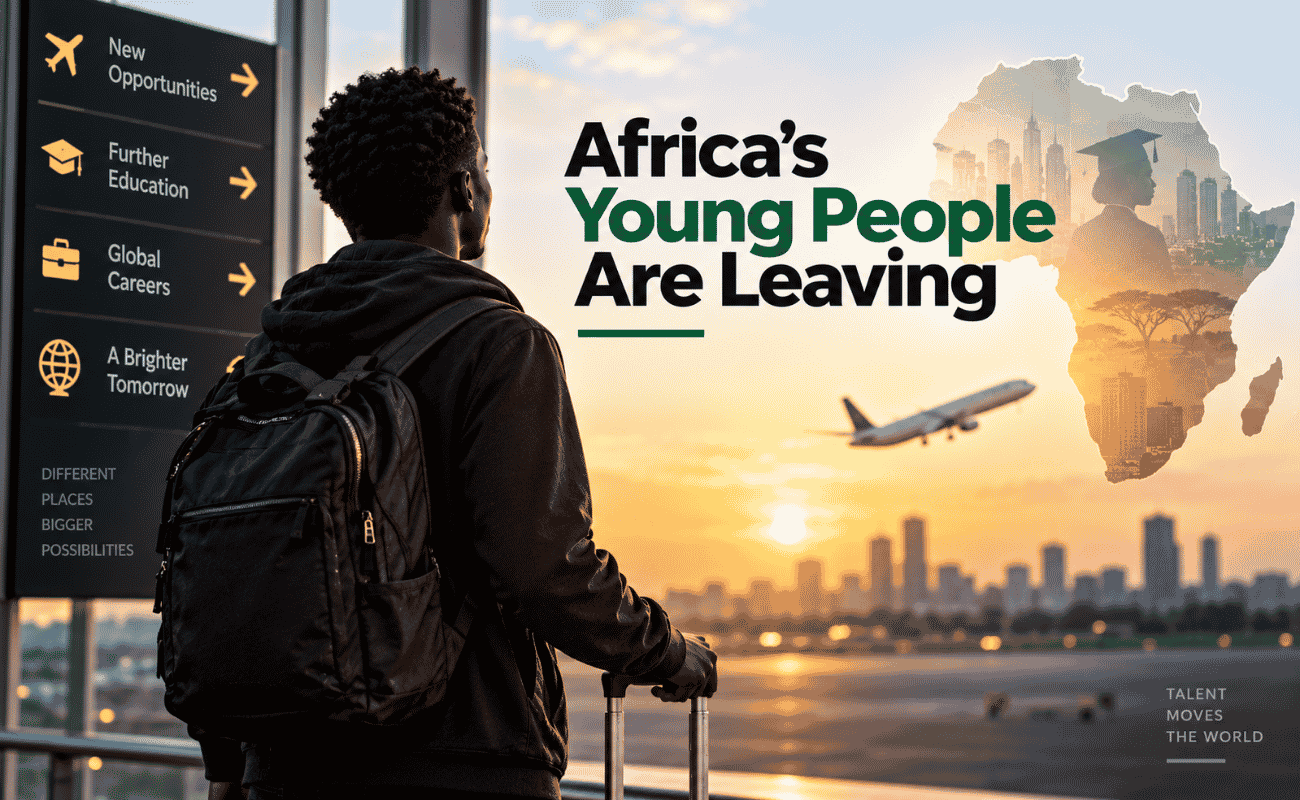
Africa is the world’s youngest continent with over sixty percent of its population under 25 years old. This demographic reality represents one of its greatest opportunities and equally one of its major challenges. A large and youthful population can provide Africa with a dynamic workforce, a growing consumer market, a generation that drives innovation, entrepreneurship, economic and social growth. However, these opportunities have constraints such as unemployment, lack of social mobility, conflicts, weak public services, unequal access to social and economic opportunities. For many young Africans, these constraints have made migration an attractive option. Millions of young Africans are entering adulthood with ambitions for employment, education, entrepreneurship and a better quality of life. Increasingly, however many believe those opportunities are easier to find elsewhere. Migration itself is not a new concept as Africans have always moved across borders in search of better “opportunities” in areas like education, employment and perceived sense of safety in these countries they migrate to. Migration is not inherently negative, but what is concerning is the growing number of young Africans who aspire to leave and what those aspirations reveal about the state of the continent in areas of employment, economic opportunity and governance.
Recent Afrobarometer findings show that across 38 African countries, 55% of young people aged 18-35 said they had considered emigrating. Among these potential young emigrants, 52% identified better work opportunities as their main motivation, while 18% cited economic hardship. The findings suggest that migration is often less about rejecting Africa or not wanting to stay in one’s homeland than about pursuing socioeconomic opportunities abroad .
The broader Afrobarometer African Insights 2026: Beyond Borders report reinforces this economic explanation. From the 38 countries surveyed, 45% of respondents said that they thought about migrating to another country at least “a little bit” while 32% said they have thought about migration “a lot”. Half (50%) of potential migrants said they would leave in search of “greener pasture” work, while another 29% want to escape economic hardship.
The economics of leaving: The reasons behind the increase in migration
Unemployment is at the heart of African migration issues. African’s population is growing rapidly but the continent has struggled to create enough productive jobs for its expanding workforce. The World Bank estimates that Africa’s working age population will approximately increase by 450 million people, an increase of nearly 70% by 2035. Yet, at the current pace of job creation, only around 100 million additional jobs are expected to be generated by this growing workforce at the rate at which the growth is happening. This creates a profound policy contradiction. Africa is accumulating an enormous poll of human capital at precisely the time when its economies are struggling. A young population can generate a demographic dividend when people are educated and employed. Without sufficient employment, however, the same large population expansion can intensify economic insecurity and pressure on governments. For many young Africans, the most logical reasoning is therefore straightforward, if a university degree, professional qualifications or entrepreneurial ambitions produce limited opportunities domestically, then migration overseas becomes the tangible option.
Africans are not simply leaving Africa
It is a popular misconception that African migration moves primarily from Africa to Europe or North America. Migration within Africa is significantly higher than migration outside of Africa. According to UNICEF’s 2024 Data Snapshot of Migrant and Displaced Children in Africa, more than 20.9 million Africans were living in a country other than their country of birth but elsewhere on the continent as of 2020. By comparison, 19.6 million Africans had migrated outside the continent. This distinction matters because the African migration story is not simply about young people crossing the Mediterranean or moving to Britain, Canada, or the United states. Africans also move within the continents, between neighboring countries, from rural areas to cities and toward regional economic centers. These movements can be understood as a form of economic integration as people tend to move towards places where they believe opportunities are greater.
Young talents are leaving, at what cost?
Migration is not inherently negative as it can generate important benefits for African economies such as migrants developing new skills abroad, diaspora communities facilitating investment, entrepreneurship and knowledge transfer. However, persistent outward migration can also create a human-capital problem, particularly when highly trained professionals leave sectors that already face shortages of manpower.
Healthcare provides a good example. The World Health Organization’s State of the Health workforce in Africa 2026 finds that African’s health workforce has expanded substantially, but significant shortages, unemployment and migration pressures exist as it’s not enough to train more health workers but to create working conditions necessary to retain them. The WHO’s findings show that African countries can experience shortages of health workers while simultaneously having well trained professionals seeking opportunities abroad.
The issue extends beyond healthcare to other sectors including engineering, academics, and technology. Skilled and unskilled professionals experience brain drain because domestic opportunities are limited. The issue is not simply that Africans are leaving; it is that many economies in Africa are struggling to create conditions in which their own human capital can flourish.
Africa’s choice to make
Africa’s demographic trajectory makes this issue increasingly urgent as the continent is entering a phase in which its working-age population will expand dramatically. The World Bank argues that this expanding workforce could transform the continent if supported by investments in human capital, infrastructure, and job creation. The opportunity is enormous as a large working-age population can generate higher economic growth, but demographic growth does not automatically produce a demographic dividend. As long as economic opportunities remain scarce in Africa, migration will remain an attractive alternative. The objective, therefore, should not be to build an Africa that prevents its young people from migrating, rather, it should be to build an Africa where migration is a choice and not a necessity.