
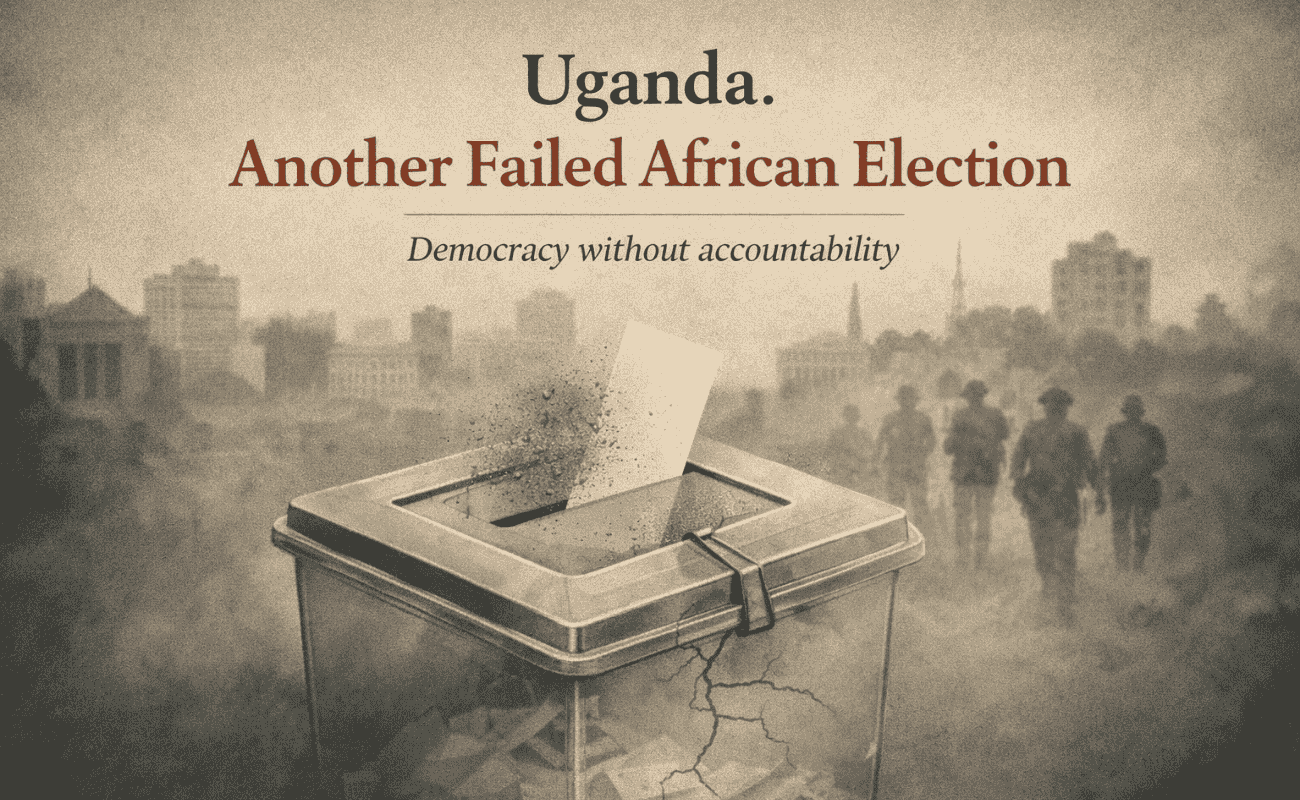
Uganda: Another Failed African Election
By Assam Francis
I’ve been trying to process the news coming out of Kampala for the last few weeks, or rather the lack of it, and I can’t shake off a profound sense of deja vu. What happened in Uganda on January 15 wasn’t an election. It was a crime scene where the victim was democracy and the perpetrators didn’t even bother to wear masks.
By now, we all know the official script, President Yoweri Museveni, President since 1986, has been declared the winner, extending his grip on power to 40 years. But let’s be honest with ourselves. This victory doesn’t feel like a mandate; it feels like a heist. And the tragedy is that Uganda has dragged Africa back into the wrong kind of spotlight, reminding the world that on this continent, the incumbent’s curse is alive and well.
The sheer audacity of the regime’s tactics this time around was breathtaking. It wasn’t enough to just rig the numbers; they had to blind the witnesses, too. Shutting down the internet for four days? That is the behavior of a government terrified of its own people. It’s a strategy we are seeing too often, the modern dictator’s favorite “pause button.” While the country was plunged into digital darkness, the machinery of the state was busy manufacturing a landslide victory and crushing dissent.
And look at what is happening to Robert Kyagulanyi, the man the world knows as Bobi Wine. The images of his home under siege by the military are haunting. When a regime treats a presidential candidate like an armed insurgent, surrounding his house and terrorizing his family, they are sending a message that goes beyond politics. They are saying that opposition is illegal. The violence we’ve seen in places like Butambala, the arrests, the beatings, it’s all part of a calculated effort to break the spirit of a generation that dared to ask for something different.
Uganda isn’t an isolated incident. It’s a symptom of a virus spreading across our region. If you look closely, the script in Kampala looks terrifyingly similar to what we watched in Tanzania and Cameroon. It is a copy and paste authoritarianism where the methods are identical: first you capture the courts, then you intimidate the voters, and finally, you pull the plug on the internet to hide the evidence. It seems our leaders are learning from each other faster than we can hold them accountable.
The silence from the African Union is not just disappointing; it’s dangerous. The AU has seemingly reduced itself to a spectator sport, issuing lukewarm statements about restraint while citizens are being brutalized for trying to protect their votes. It is a hypocrisy that stings. We see ECOWAS and the AU rush to sanction military officers who seize power in West Africa, yet they roll out the red carpet for civilian leaders who seize power through constitutional manipulation and electoral fraud. What is the difference, really, between a coup executed with guns and a coup executed with falsified tally sheets? The result for the common man is the same, voicelessness.
This failure of our institutions to draw a line in the sand is bringing a terrifying new reality. You can feel it in the conversations on the streets and in the frustration of the youth. There is a growing, dangerous sentiment brewing, a nostalgia for the boot.
We are reaching a breaking point where citizens are so tired of rigged elections and broken promises that they are starting to view the military not as a threat, but as a solution. We saw it in Gabon, we saw it in Guinea, and we are hearing whispers of it in East Africa now. When the ballot box becomes a dead end, the barracks start to look like an exit door.
Let’s be clear, military rule is not the answer. History has taught us that soldiers rarely make good governors, and the savior usually ends up becoming the new oppressor. But we cannot blame a drowning man for grabbing a floating sword. If democracy fails to put food on the table, if it fails to deliver security, and if it fails to respect the will of the people, then the people will inevitably turn to whoever promises to burn the system down.
The events in Uganda are a warning we cannot afford to ignore. We are pushing our youth into a corner. If the African Union and our regional bodies don’t wake up and start treating election theft with the same severity as they treat military coups, they are practically inviting the soldiers back into the presidential palaces.
We need a hard reset. We need judicial systems that don’t bow to the executive, and we need regional bodies that protect the people, not the presidents. Because if meaningful changes are not made soon, African citizens will continue to side with military takeovers in a desperate bid for normalcy, even if we all know, deep down, that it is no viable solution at all.